

What’s Your Ministry? Reviving the Ancient Georgian Supra

Updated: Sep 12, 2025
Hospitality, Connection, and the Orthodox Way of Celebration

OYM recently had the opportunity to sit down with Daniel Padrnos, founder of the Supra Dinner Society and one of the leading voices bringing the ancient Georgian feast to America. Having helped establish the first U.S. restaurant to host Supras, led pilgrimages to Georgia, and written extensively on the tradition, Daniel is passionate about the feast as more than food and drink—it is a living practice of hospitality, generosity, and shared meaning. In this conversation, he reflects on how the Supra embodies Orthodox joy, how it teaches us to truly celebrate in community, and why feasting is just as essential to our faith as fasting.
OYM: Could you give us some background on yourself—where you're from, your upbringing, and your history with the Orthodox Church specifically?
Daniel: I grew up in Colorado Springs, Colorado, and I was raised Roman Catholic in a pretty faithful family. I went to school in Spokane at a place called Gonzaga to study engineering. While I was there, I had the urge to depart from the normal path that a lot of people take after university. I didn’t necessarily want to get a 9-to-5 job. I was sort of having an existential crisis and just wanted to do what a lot of young people do—figure out what life is all about.
So I found this organization called First Things Foundation. It’s similar to the Peace Corps but with an Orthodox ethos. It was founded by a man named John Heers. This was in 2017, when he was just starting First Things, and when he hired me he told me there would be an opening at an Orthodox mission in Sierra Leone, in West Africa. I ended up signing on for two years. I knew the first year would be at this Orthodox mission in Sierra Leone, though at the time I didn’t know anything about Orthodoxy. I definitely had no intention of learning more, really.
But while I was at this mission for my first year, I started reading Orthodox books because they were around, and I realized that some of the existential questions I had were actually, whether I liked it or not, answered by this ancient Eastern Christian faith. Slowly, I began talking to a spiritual father—a priest in Florida—and on my way out of Sierra Leone, after two years of serving locals, I was baptized on Mount Athos. That was January 2020.
Since then, I continued to work with First Things, which brought me to a lot of places around the world. I was basically helping Americans integrate into old-world cultures. I would hire them, train them, and then shepherd them while they were overseas. In 2021, while doing that work, I also helped First Things start a Georgian restaurant in South Carolina called Keipi.
That restaurant had two purposes. First, we wanted to bring “new worlders,” so to speak—Americans—into the old world, so they could experience a taste of reality outside this sort of matrix of our progressive society. That was something that had changed my life, and I wanted others to experience it. Second, we wanted to bring the old world into the new world through its hospitality, slow pace of life, and traditional way of being. We did this through the Georgian tradition called the Supra. That started in 2021 at Keipi.
Then, just at the beginning of this year (2025), I moved to Seattle to found the Supra Dinner Society. I’m still partnered with First Things Foundation, but we’re also registered as a nonprofit. We’re doing Supras in Seattle, but I’m also training toastmasters called Tamada, who are like the heads of the banquets in Georgia. With these Tamadas I’m training, we’re making it possible for people anywhere in the United States to experience the rich connection and depth that the Supra, this old-world tradition, gives.
OYM: We’ll touch on the Supra in a second, but I wanted to go back to something you mentioned. You were baptized on Mount Athos?
Daniel: Well, I didn’t really expect it to happen. The Orthodox priest I was speaking with in Florida—I told him I really wanted to visit the Holy Mountain. Like every convert, I’d been reading about this sacred place: no women are allowed, it still feels like the Byzantine Empire, and you hear these incredible stories of saints there. So I had it in my head that on my way back from Africa to the States, I really wanted to go.
It ended up working out, but when you try to do a good thing, the devil tries his best to prevent it. So there was a whole series of unfortunate events. When I was in Morocco, I missed my flight to Athens and got stuck there for three extra days. When I finally got to Thessaloniki, I lost my passport. And of course, Athos is its own jurisdictional area, so it was very difficult to get in without a passport, especially not being Orthodox yet. Fortunately, I had connections with priests who helped me.
When I finally made it, it was freezing cold—basically January 1st. But that was nice because there weren’t many tourists. I went to Philotheou Monastery, which is known for its hesychastic tradition. Rather than monastery-hopping like a tourist, I just wanted to stay in one place, so I stayed at Philotheou.
My trip had been cut from 12 days down to 8 because of everything that happened, but I still had 8 days on Mount Athos. When I spoke with the priest in Florida for advice, he had told me the etiquette and also said I should ask if they’d be willing to baptize me there, since he was planning to baptize me when I got back anyway.
So, I think it was Christmas Eve when I was able to speak with the abbot. He agreed, and we had a translator who spoke English translate my life confession to him. Then I was baptized the next day—on Old Calendar Christmas.
It was wild. Before baptism, on Athos they’re pretty serious about catechumens—you don’t stand in the nave, you’re in the narthex, you can’t really see much. But after baptism, suddenly I was brought in, given a place of honor opposite the bishop’s throne. When all the monks went to venerate the icons, they came and kissed my hand because I was newly illumined. At meals, I went from sitting at the far end of the dining hall to sitting next to the abbot during trapeza.
It was completely unexpected, absolutely. And even now, five years later, I’m still processing what all of that meant. But it was beautiful.

OYM: Back to the Supra Dinner Society and the ministry you’re involved in. What exactly is the Supra itself—its history and practice?
Daniel: So, the Supra actually has its origins in the Agape feast of Jerusalem. Georgian liturgics drew heavily from the Jerusalem tradition, and the Agape feast was part of that. Historically, it’s not entirely clear how the Supra itself developed. There’s evidence that some form of it existed before Christianity even came to Georgia with St. Nino in the 4th century. But the way we know it today is very much liturgical.
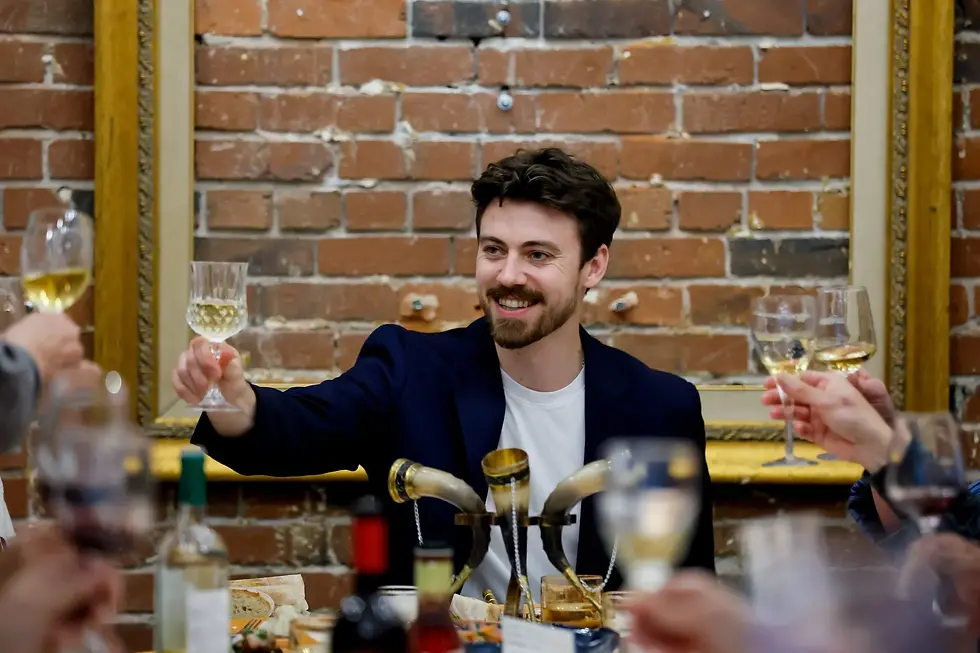
At a Supra in Georgia, there’s always a toastmaster, called the Tamada, usually a man. He leads the table through a series of themed toasts. The first toast is usually to God. The second may be to peace or to the Patriarch of Georgia. The order and themes vary by region, and the Tamada will often discern what is most appropriate for that particular gathering. But generally, you’ll have anywhere from 16 to 20 different toasts.
Georgians are known for their poetry and eloquence. Unlike in many countries, where drinking is paired with a quick word like “to your health,” Georgians—who actually invented wine 8,000 years ago—see wine as something sacred. It’s not meant to be consumed alone, and it’s not meant to be consumed casually. Each toast is accompanied by words, and when the wine is drunk, it represents ingesting those words and honoring the person who spoke them. After the Tamada gives a toast, anyone else at the table can also offer a toast, as long as it stays on the same theme.
There are always certain recurring themes—such as a toast to the departed, honoring the ancestors, and a toast to children, new life, and innocence. There is often a toast to the Mother of God and to the saints. But there can also be lighter themes, like humor or friendship. Music is always part of the Supra—folk music, traditional songs, often dancing. It really is an extra-liturgical expression of faith. For Orthodox Christians, I think it provides a beautiful model of how to truly feast—whether on a feast day, at a wedding, or even in mourning at a funeral.
OYM: So what does the Supra Dinner Society seek to do? What is your ministry’s purpose?
Daniel: Good question. We host Supras for anyone. We really do have two types. One is the community table, where anyone can sign up for a seat. It could be Orthodox people, non-religious people, liberal or conservative—it’s a diverse mix. Usually around 20 people, and we’re now doing them weekly, maybe soon twice a week.
At these dinners, the Tamada leads the toasts, but we make them accessible. The first toast is often gratitude—thanking God for everything, but expressed in a way that anyone can connect with. We avoid language that would alienate someone. So the themes are things like family, mothers, adventure, and suffering. And what happens is that people—even across political divides—find themselves recognizing one another as human beings. In that recognition, they’re really seeing the image of God in one another, even if they don’t call it that.
At these community Supras, people often get very vulnerable. They open up, learn new things about themselves, make new friends, or even discover new depths in people they already knew.
The second type is private Supras. These are for occasions like weddings, rehearsal dinners, company retreats, or client appreciation events. For these, we adapt the toasts to fit the occasion. A wedding might have certain toasts that wouldn’t appear at a business dinner, for instance. That’s part of the beauty of the Supra—it’s both structured and flexible. There’s no rigid canon. The structure actually creates space for creativity and for the unique voice of each table.
This is very different from the typical American dinner, where the food just gets put on the table and conversation drifts wherever. In Georgia, it’s simply etiquette—normal—that wine is accompanied by a Tamada who guides the table through toasts. What we’re really doing in America is introducing Georgian etiquette to American dinners. And people find that the structure—far from limiting—actually adds depth, meaning, and even poetry they didn’t know they were capable of.
OYM: Was there a specific moment where you realized that the Supra Dinner Society—or just this exposure to the Supra—wasn’t just a cultural tradition, but something you needed to share with others, almost like a ministry?
Daniel: It really started with working with John Heers and First Things Foundation. John worked in Georgia in the 90s, basically helping people recover after the Civil War and perestroika. And while he was there, he encountered this incredible form of hospitality that he later introduced me to.
At first, it looked like him just showing up as a volunteer—bringing food, rice, basic supplies. But he was the only American in this village, and Georgians hadn’t had much exposure to Americans at the time. Still, they welcomed him into their homes. If you’ve ever been to Georgia, you know they’ll say the same thing to every guest: “Every guest who comes into our home is a gift from God.” And it’s not just a saying—it’s truly practiced.
When you walk into a Georgian home, you’re overwhelmed by the hospitality. If they hear you’re coming, they’ll prepare a whole feast. I’ve even landed on flights at 3 a.m., and still been welcomed into a house where ten people had been working all day preparing food, just because they knew a guest—a gift from God—was arriving.
That’s what John experienced in the 90s. These were impoverished people, yet they still brought out the very best for him. He realized they weren’t thinking about economics the way we do—they were offering hospitality as a way of life. And it was nourishing, not only for him but for them.
So when John came back to the States, he started casually hosting Supras with friends in New York and Florida. Later, when he started First Things Foundation, he began using Supras as fundraising events. To his surprise, Americans loved it—this tradition resonated deeply.
When I joined First Things Foundation in 2017, John actually flew to my house in Colorado and told me to organize a dinner. I had about 45 friends, family, and neighbors there, and John served as the Tamada. That was my first Supra. From then on, every new field worker with First Things would have a Supra at their home as part of their orientation. It was a way to welcome their family into the mission, because the work overseas really mirrors the ethos of the Supra: slowing down, listening, communing with others, and letting something grow naturally.
To circle back to your question, the more we did this, the more we realized: the Supra wasn’t just a nice tradition to enjoy once in a while—it was transformative. It wasn’t only about overseas work; it had a real impact here in America too. Eventually, John and I thought, What if we started a restaurant? Neither of us had restaurant experience, but the idea wouldn’t leave us.
At first it was just talk, but then someone offered us a donation to make it happen. That’s when it became serious. We kind of had no choice at that point. So Keipi was born. And now, four years later, it’s still open.
At the beginning, we didn’t know if people would even come to Supras. We thought maybe it would last a month or two. But now Keipi hosts three or four Supras every week. That growth is what eventually led to the Supra Dinner Society. People from around the country started reaching out: “Can you do a Supra for my wedding? For my company?” It just felt like the natural next step.
For me, that meant moving to Seattle. There’s a bigger population here, more opportunities, and I also have family nearby. Seattle is now our base, where I’m training Tamadas and creating resources so people can start hosting Supras on their own.

OYM: What does a typical day working in your ministry look like? And maybe to add onto that—let’s say I wanted to start hosting a Supra. What would that look like, going through you?
Daniel: Well, a typical day is just like any other entrepreneur—every day looks a little different. For example, today I found a china hutch on Facebook Marketplace that I might pick up to bring to our event space. I’m tinkering with the SEO of our website, creating an Instagram post, answering emails from people who want to host a Supra in Asheville or Colorado, and coordinating with our caterer for three upcoming events. Later this afternoon, I have a meeting with our Georgian wine supplier to bring in some new varieties for the Supras.
And then there’s the behind-the-scenes stuff too—figuring out how to keep up with accounting so we don’t get in trouble with the IRS. (laughs) So yeah, every day is different.
But of course, a big part of it is actually Tamada-ing Supras. That happens at least once a week, if not more. For those, I’ll usually call all the guests ahead of time for the community tables and try to be as hospitable as possible—greeting people at the door, making sure they feel welcomed.
And honestly, that’s one of the main things the Supra is teaching me: hospitality and abundance. Personally, I tend to be a little miserly by nature. And I think maybe that’s exactly why God nudged me into this work, because the Supra is the opposite of that. It’s about offering without expecting anything in return.
Every Supra is like that—you never run out of wine to offer, there’s always room to stay a little longer, even when you’re tired and ready for bed. There’s always another conversation to have, and often, it’s those late-night, unplanned conversations where people really open up about their stories.
So that’s what a “day in the life” of this work looks like. A mix of logistics, creativity, and administration—but at the center, it’s always about creating a space for generosity, abundance, and connection.
OYM: If someone were to come up to the Supra Dinner Society and say, “Hi, I’d like to host a Supra and I’d love your help,” what would that process look like? What do you actually provide?
Daniel: I usually direct people to our website—that’s always the best place to start. We have some videos up there that are really helpful because a lot of people experience a Supra and think, “Wow, I want to do this with my friends and family.” But then they get stuck trying to explain what it is or why it’s worth doing. So the videos help give people a sense of the experience if they’ve never seen it before.
From there, we provide a number of things to help you put everything together. Of course, it depends on the budget, but the key element we always provide is a Tamada—the toastmaster. Right now that’s usually me, or sometimes John, because I’m still training more people to do it.
We also help with food. You might be surprised how many cities actually have Georgian restaurants or caterers. Over the years, I’ve built a pretty good network of them, so it’s usually not hard to arrange. Same with Georgian wine—we’ve streamlined that process quite a bit. If people need help picking a venue, we can guide that too.
Basically, if you have a venue, Georgian food, Georgian wine, and a Tamada, you can host a Supra. Beyond that, there are lots of small details we walk people through—things like music setup, table cards, or the best table formation for conversation and toasting. We make that a personalized process.
For those who want to try hosting on their own, we’re also creating resources. Right now I send people a PDF guide, but I’ll admit it’s tough to be a Tamada without experiencing one firsthand. That’s why we’re working on a Tamada training course—probably a seven or eight video masterclass, really immersive, that goes deep into how to facilitate a meaningful table.
On top of that, we’re developing a game called Toasting Topics. It’s a deck of cards with different toasting prompts, plus a booklet of variations for how to use them. The idea is that anyone could facilitate a Supra with those prompts, even if they don’t have a trained Tamada.
So right now, if people reach out, it’s a very personal process—my email is on the website, and I love walking people through it. But we’re also building more tools so that eventually, anyone anywhere can host a Supra meaningfully.
OYM: What would you consider the biggest challenge you’ve faced in starting or running the Supra Dinner Society?
Daniel: Honestly, the hardest part is just the initial spark. Because as soon as people experience the supra, they can’t stop talking about it. Once someone has been part of it, you know they’ll tell others or want to bring it back to their own community. It’s very rare for someone to walk away thinking, “That was just another dinner I’ll forget about.”
The challenge is conveying that to people who haven’t experienced it. It’s such an intimate, personal, and heartfelt gathering. You can only explain so much in words or videos, but you can’t really feel it until you’re at the table. The Supra isn’t entertainment—it’s participatory. Everyone who shows up is contributing, like voices in a polyphonic song. Each person adds their own part, and without it, the table wouldn’t be complete. That’s something missing from much of our hospitality and entertainment culture today: the idea that you need to give of yourself in order to receive something pure.
And that’s what the Supra offers. It’s not forced—no one is obligated to give a toast—but the environment invites vulnerability and openness. That’s what makes it special, but also difficult to communicate to outsiders.
When I first moved to Seattle, for example, maybe only three or four people had ever experienced a supra. It took a lot of effort just to get people to show up and build that momentum. But now it’s accelerating. We had a writer from the Seattle Times come and do a beautiful piece, plus an NPR podcast, and since then we’ve basically had a waitlist.
The other big challenge now is Tamadas. I can’t lead every Supra myself—I’m traveling a lot, and we need Tamadas to host both here in Seattle and in other places. The role requires a unique balance of charisma and listening. A lot of people think being a Tamada just means being loud and charismatic, but that’s not true. Some of the best Tamadas are actually the best listeners. The trick is finding someone who can both listen deeply and still step into that central role without fear.
Training Tamadas has been a challenge, but also a joy. It’s exciting to collaborate with someone, watch them lead their first Supra, and then debrief afterward: “Maybe this toast went on too long,” or “I should have stepped in here.” It’s really an art and a craft, and being able to mentor others in it is incredibly rewarding.

OYM: Obviously, your ministry and the Supra as a whole are rooted in hospitality, generosity, and deep human connection. How do you see the values of the Supra shaping our lives as Orthodox Christians?
Daniel:I think the Supra is an opportunity to celebrate in a way that many New World Orthodox don’t even know how to do. There are lots of canons and prescriptions for how to fast, but not really for how to feast. Feasting is usually a cultural overflow, something that just naturally develops. In Georgia, which has been Orthodox for 1700 years, the Supra has grown out of that rhythm of fasting and feasting as an expression of the faith.
You see it in the small things. These practices take time to develop within a culture. And for us, as Americans, it’s a gift to be able to see and learn from these expressions in older Orthodox countries that don’t have some of the baggage we carry—whether Protestant or just broadly cultural.
Whenever I talk to Orthodox Americans who’ve experienced the Supra, they always say, “This is the only way I celebrate feasts now.” They’ll ask, “How can you celebrate Pascha without a Supra? How can you celebrate Pentecost without a Supra?” And I think they’re right—it’s a way of feasting that feels deeply appropriate.
Because you can’t get rid of feasting. You can try to suppress it—Puritans tried—but the energy always leaks out in unhealthy ways. The Supra channels that energy into something meaningful. The toasts themselves become a way of unpacking the deep meaning of each feast. People have been fasting, preparing, gathering their attention—and then in the celebration, that meaning overflows into words, into song, into shared reflection.
It’s the same for weddings. A wedding isn’t just a party—it’s two people coming together, becoming one, creating abundance, creating family. That’s a mystery. And the Supra helps us not only contemplate mysteries like that, but actually participate in them.
It even reshapes the way we look at wine. Wine isn’t just about its chemical or alcoholic properties. It becomes something more—something like blood, something shared, even sacred. And the Georgians can teach us this. First, because they invented wine. And second, because they’ve developed such a rich, reverent way of interacting with it.
OYM: You clearly have this wonderful gift of wanting to share generosity and hospitality through the Supra: bringing people together and showing that food can be more than just sustenance—it can be a way to experience something deep and meaningful.
And we know so many young Orthodox people do have gifts. What advice would you give to someone who wants to start their own ministry, or who wants to use their gifts to serve the Church?
Daniel: There’s a classic toast you’ll hear in Georgia, a toast to heroes and leaders. The Tamada will hold up a glass of wine and say something like: when a child thinks of a hero or a leader, they might imagine someone with a glass full of abundant gifts and knowledge.
But that’s not what makes a true leader or hero. A true hero pours out everything they have. The Tamada will demonstrate this by pouring out the glass of wine into another cup, and then raising the now-empty glass and saying: “this is what a true leader looks like. Someone who doesn’t cling to their gifts, but empties them out for others.”
And I think that speaks directly to your question. Too often, I think people in their twenties are told they should already have this great sense of self-esteem, or this pride in their gifts. But that can make young people stagnant. My advice is: pour yourself into something, completely. It might not end up being the “perfect” thing, but when you’re young, it’s okay. The act of giving yourself wholly to something will shape you. Out of that sacrifice, something real will come. True abilities and gifts are usually discovered through that outpouring, not just sitting latent inside you. That’s how you gain self-knowledge.
I can say that from my own experience. After I graduated college, I joined an organization called First Things Foundation. I was searching for meaning, for adventure; but I didn’t want to do one of those overseas programs that’s just “pat yourself on the back, we did a good job.” First Things is the opposite. They send you to an old-world place, and for the first year you don’t try to start projects or “fix” anything. You just work a local job—construction, farming, carpentry, whatever the community does. That’s how you integrate, that’s how you learn the language.
Then, in the second year, you start helping local entrepreneurs—people with their own ideas—by offering support, connecting them with grants or resources. It’s this beautiful two-year process: first you empty yourself, then you discover how you can truly serve.
OYM: Do you have any concluding thoughts you’d like to share with our readers?
Daniel: We’re actually planning a Supra with OYM in Chicago. It’s going to be a kind of pan-Orthodox Supra. I just think that’s the coolest idea—having Serbians, Russians, Greeks, hopefully Georgians, Bulgarians—different groups all at the table together. And the beauty is, it’s not about eliminating the differences, but about sharing them. I think that’s something that could really happen more in America. If anybody wants to host or experience a Supra, you can visit our website at supradinner.com. My email is daniel@supradinner.com, so feel free to reach out directly. If you subscribe to our email list or follow our Instagram page, I’ll be sharing updates about some exciting things we’re working on—like a toasting topics game we’re producing, a video series on how to become a Tamada, as well as announcements for upcoming events.


